Thursday, June 18th, 2026
Black Montmartre in the Jazz Age
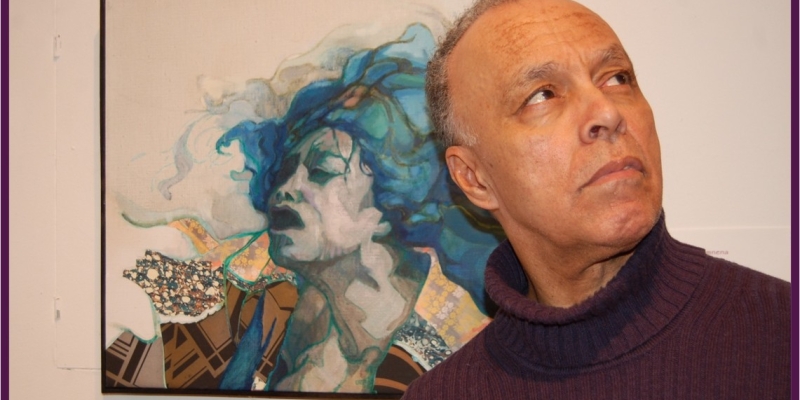
Cover image: Robert Tomlinson and his painting entitled Anna Comnena (The Screaming Woman)
Image from Black Montmartre in the Jazz Age media kit
Robert Tomlinson's Black Montmartre in the Jazz Age is a labor of love.
Almost 10 years in the making, his book is a three-part exploration of the seminal era of Paris history and culture that revolved around France's embracing of jazz.
The general public likely associates this era with Josephine Baker's rise to stardom.
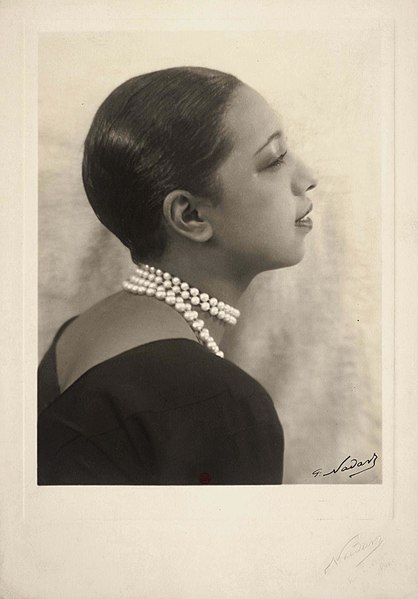
Josephine Baker - 1930 - Nadar photo portrait
Image in the public domain
Black Paris aficionados may be able to go a step farther and recount the story of Black regiments—most famously, the Harlem Hellfighters under the command of Lieutenant James Reese Europe—introducing France to jazz during the First World War.
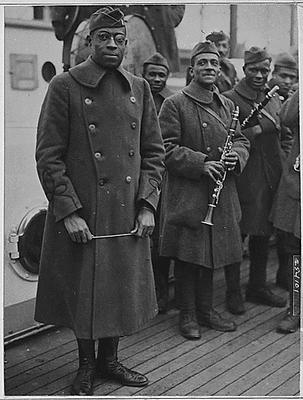
U.S. National Archives and Records Administration
But the story runs much deeper than this, and Tomlinson leaves no stone unturned as he reveals it. For the period between World War I and the 1929 Stock Market Crash, he provides thoroughly referenced names, dates, locations, and narratives that paint a vivid picture of the environment that allowed the music, and the musicians who played it, to thrive.
One of the reasons I appreciate this book so much is that it explores "Black Montmartre" from a geographical perspective and provides intricate detail about the area I present during Entrée to Black Paris' "In the Shadow of Montmartre" walking tour.
In fact, I dedicated this tour to Tomlinson because his research enriches it significantly.
I recently visited Tomlinson at his Paris home to talk about the book and get my copy autographed.
 Tomlinson autographing Black Montmartre in the Jazz Age
© Entrée to Black Paris
Part I of Black Montmartre in the Jazz Age examines the early history of jazz in the French capital as it unfolds in clandestine nightspots on rue Caumartin. Those who know the city will rightly place these White-owned clubs on the 9th arrondissement thoroughfare that runs north-south from boulevard des Capucines, past the Printemps department store and the Saint-Louis d'Antin church, and up to rue Saint-Lazare. They were clustered in the southernmost section of the street near the Olympia Theater.
At the end of Part I, Tomlinson describes the event that drives the night scene from this area to what is "properly" referred to as "Black Montmartre"—the neighborhood we now know as Pigalle. It is north and east of rue Caumartin.
Part II is entitled "On the rue Fontaine." On this northwesterly running street that ends with a splendid view of the Moulin Rouge, we find the "famous" Zelli's Royal Box and the many iterations of a club first owned by "Jed" Kiley. Both of these establishments were White-owned, with Black musicians often providing the entertainment.
But Tomlinson also devotes an entire chapter in this section of the book to the Black-owned Tempo Club, which operated above Zelli's and predated the years when Black-owned and operated clubs dominated the scene. He mentions African-American Eugene Bullard's 1930s club, l'Escadrille, here as well as in the epilogue, but focuses more on Bullard in other parts of the book.
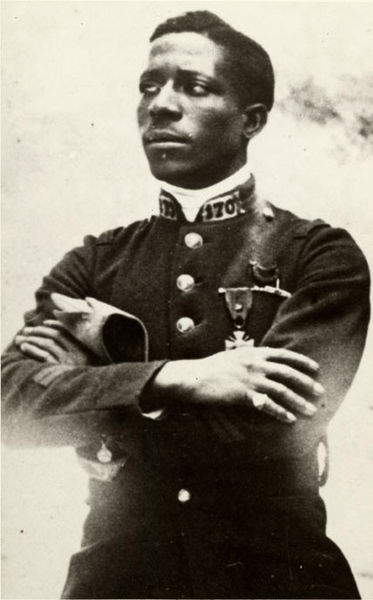 Eugene Bullard in WWI uniform
Image in public domain
Part III centers on the clubs operating on rue Pigalle, a quiet, one-way street that runs northeast from rue Blanche to Place Pigalle and boulevard de Clichy. The backstory for the Black-owned and/or operated Grand Duc, Mitchell's, Chez Florence, and Bricktop's are recounted here. The Grand Duc began as a White-owned club, but passed into the hands of Gene Bullard and then Bricktop. Black-owned Mitchell's, Chez Florence, and Bricktop's (Ada "Bricktop" Smith opened several clubs after owning The Grand Duc) flourished during the 1920s.
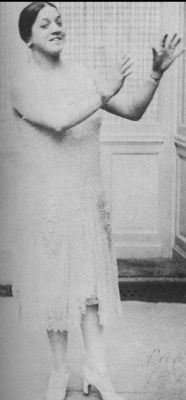 Ada Bricktop Smith at Le Grand Duc
Image from Bricktop by Bricktop with James Haskins
Fair use claim
Two B&W plate sections illustrate the book. Images consist of illustrations, photo portraits, advertisements, and landscape photos of venues.
The extreme care with which Tomlinson researched in Black Montmartre in the Jazz Age is evident. He talks about the incredible diversity of the crowds that patronized the clubs in Montmartre—people from as far east as India and as far west as Hawaii (which was a U.S. territory at the time). He quips that one of his sources of information, Basil Woon, wrote that these people would be more justly called "Tout-Etranger" (All Foreigners) than "Tout-Paris" (All Parisians)—the name true Parisians facetiously called them.
Tomlinson also systematically dismantles the "myth of a colorblind France" that so many African Americans believed was true of the era. While Black Americans were largely treated much better in France than they were at home, White Americans who were also part of the diversifying mix of people in Paris were known to express racist beliefs and act on them.
U.S. writers were frequently prone to reducing Black Americans to stereotypes, particularly in the press.
And the French, whether naively or deliberately, often did the same.
There is a touch of "gossip column" energy that runs through Black Montmartre. One example of this is Tomlinson's report of the murder of Leon Crutcher of the Southern Syncopated Orchestra by his French wife—an act incited by his flagrant carousing and womanizing. Another is the recounting of the tangled web of British heiress Nancy Cunard's love life: she famously dumped French writer Louis Aragon for African-American musician Henry Crowder, only to later replace Crowder with African-American boxer Bob Scanlon.
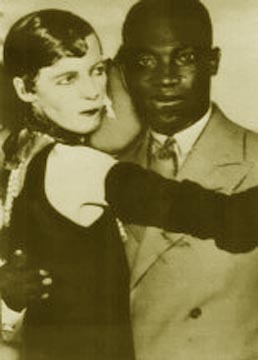 Nancy Cunard and an unidentified Black man*
Image in public domain
Source: Wikimedia Commons
If you're interested in a rigorous and absolutely engaging look at this intriguing time in Paris history, I highly recommend Black Montmartre in the Jazz Age. It is available for purchase online at:
 Tomlinson holding Black Montmartre in the Jazz Age
© Entrée to Black Paris
*While Henry Crowder is listed in the caption on the Wikimedia Commons page where this image is housed, the description reads: "Nancy Cunard and some unidentified man." Having seen photos of Bob Scanlon, I believe he may be the man in this image.
